
Numbers for computing
The computing disciplines utilize several different number systems, and these videos endeavor to give you the basic familiarity you will need with those number systems in your future courses.
If you wish to access the slides used in the videos, they are available for download.
1 Overview
Video: ~12 minutes
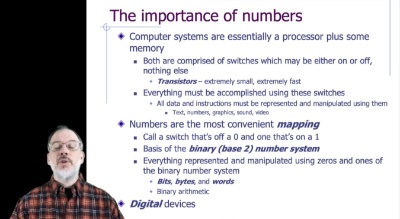
This video explains the intimate interconnections between the transistors that comprise our modern computers and values expressed in the binary number system. It introduces the concepts of bits, bytes, and words and lays the essential groundwork for the rest of the videos in this series.
2 Common Number Systems
Video: ~16 minutes
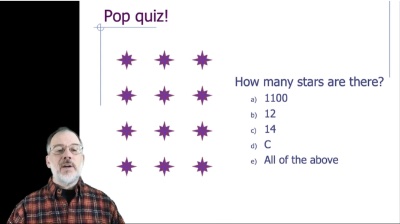
This video introduces the four number systems that are commonly encountered in computing practice—binary, decimal, octal, and hexadecimal (or hex)—and begins exploring the relationship between a number system’s base and its various other properties.
3 Counting in Decimal
Video: ~19 minutes
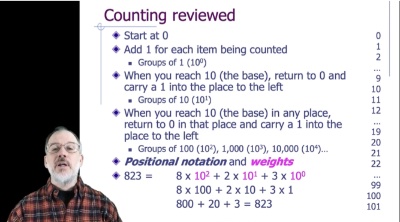
A review of the mechanics of counting, including the powers of the base, weights, and positional notation. Although the familiar decimal number system is used for this video (and you presumably already know how to count), it is important to watch this video in order to fully understand those that follow.
4 Counting in Other Bases
Video: ~19 minutes
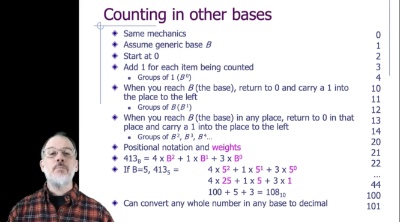
This video builds upon the review of the previous video, which you should definitely watch first, to explain how to apply the same basic mechanics of counting in number systems with bases other than the familiar 10.
5 Converting to Decimal
Video: ~18 minutes
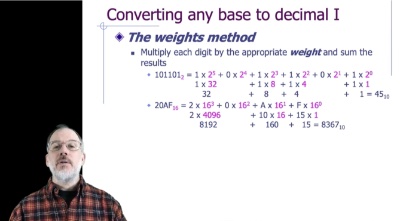
This video introduces two techniques for converting values expressed in any other number system into values in our familiar decimal number system—the weights method and the multiplication method.
6 Converting from Decimal
Video: ~18 minutes
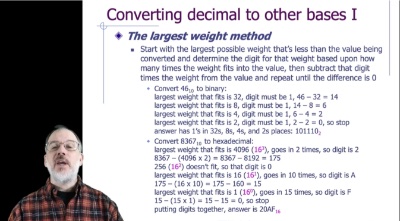
This video introduces two techniques for converting values expressed in our familiar decimal number system into their equivalent representation in any other number system—the largest weight method and the division method.
7 Binary, Hex, and Octal
Video: ~22 minutes
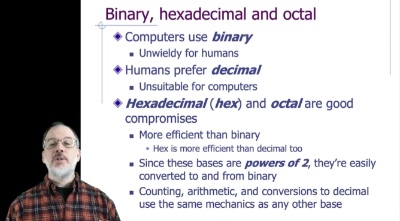
This video introduces simple substitution techniques for converting values among their representations in the binary, octal, and hexadecimal number systems, illustrating why octal and hexadecimal are so useful in the computing disciplines.
8 Arithmetic
Video: ~23 minutes
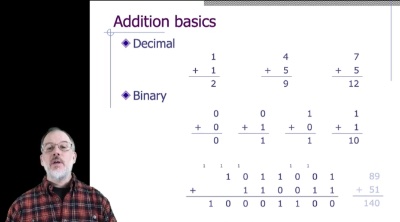
This video gives you a chance to see that the basic properties of arithmetic hold across number systems, so that you can add, subtract, multiply, and divide values without first having to convert them to decimal representation.
9 Fractions
Video: ~25 minutes
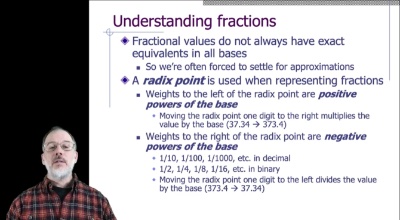
This video extends the material of the previous videos on this subject to explain how fractions and values with fractional parts are expressed in various number systems.